Reopening the Strait of Hormuz: What Will Really Happen to Oil and Freight?
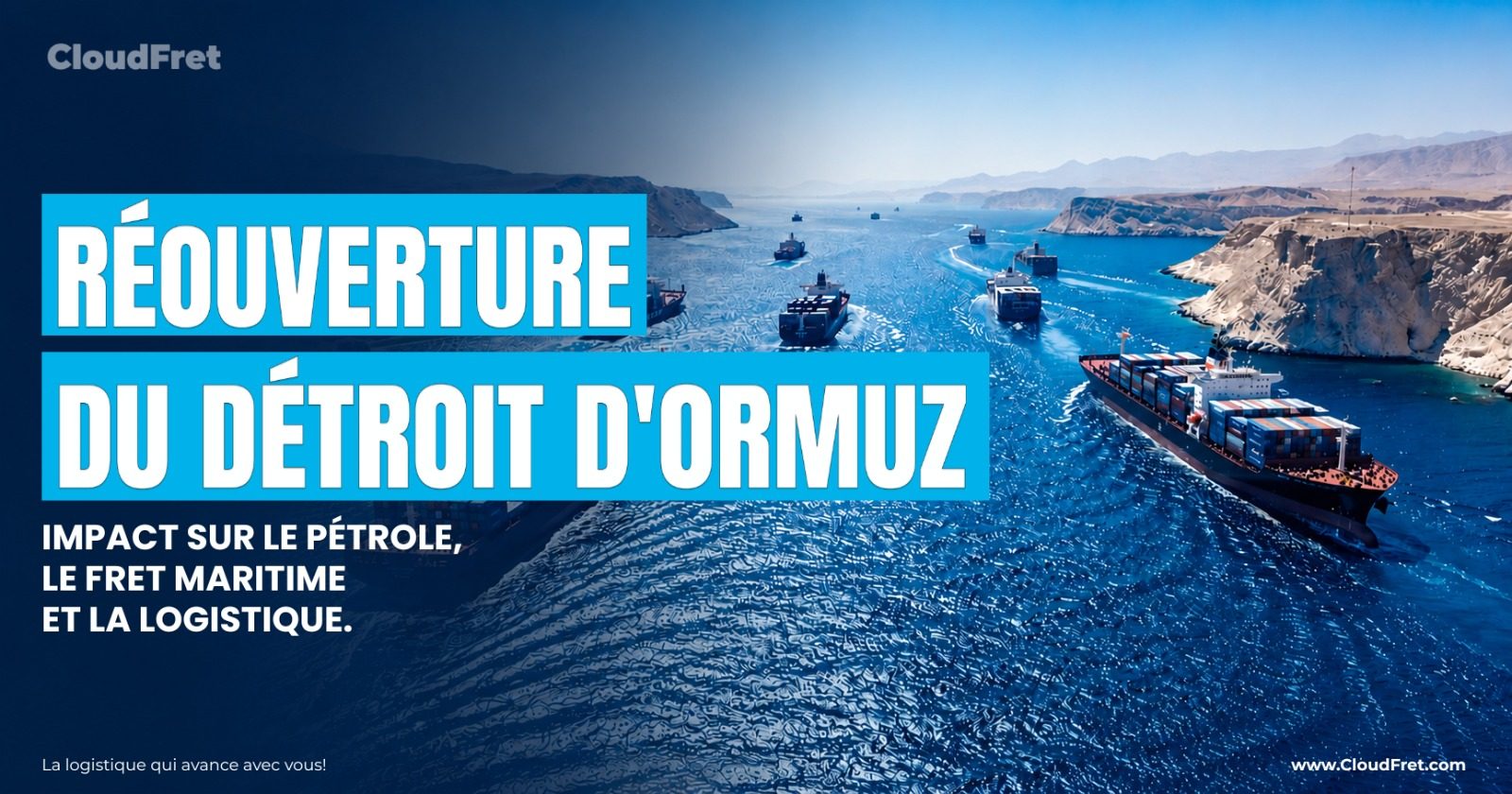
The Strait of Hormuz, a strategic chokepoint through which a considerable share of the world’s oil and liquefied natural gas passes, is about to reopen after nearly four months of closure caused by the conflict between the United States and Iran. On paper, the news looks like a genuine relief for energy markets and international trade. In reality, the return to normal looks set to be gradual and fraught with logistical and security uncertainties. Here is what the reopening of the Strait of Hormuz really changes for oil prices, shipping and supply chains — including for Moroccan importers and exporters.
A Deal Signed, but a Phased Reopening
US President Donald Trump and his Iranian counterpart Masoud Pezeshkian signed a memorandum of understanding on Wednesday evening formally ending hostilities. The text provides for the full reopening of the Strait of Hormuz, with no toll imposed by Iran, for a period of at least sixty days. When the agreement was announced, the price of a barrel briefly fell back below $80, as traders anticipated the restoration of the oil, LNG and goods flows that had been blocked since the start of the conflict.
Even so, shipping specialists warn that an instant restart should not be expected. The most likely scenario is a step-by-step recovery, overseen by a traffic management mechanism involving Iran and Oman. Several questions remain open — prior transit authorisation, possible service fees, acceptance of foreign naval escorts, and any remaining mines — and each of these unknowns could slow the pace.
Why Traffic Will Not Resume Overnight
Reopening a strait politically is not enough to get ships moving through it. Before any return to normal, naval forces must certify safe navigation corridors, an operation that takes several days. War-risk insurers must then reinstate their cover: without insurance, no shipowner will move its vessels. The Omani, Emirati and Iranian authorities will also have to coordinate shipping lanes, convoy systems and transit windows.
Mine clearance is another particularly sensitive issue. Until there is complete certainty that no mines remain, only narrow passages are navigable and caution prevails. Experts point to the precedent of the Red Sea: even after the first signs of de-escalation, many operators long hesitated to return, for lack of lasting proof of safety. Insurers, for their part, will require a stable and predictable environment before lowering their additional premiums, which remain highly sensitive to a vessel’s flag, ownership and navigation history.
A Backlog of More Than a Hundred Ships to Clear
Before the conflict, between 650 and 770 merchant vessels passed through the strait each week, or roughly 90 to 110 transits a day in both directions. Today, the picture is very different: more than a hundred tankers are estimated to be stuck in the Persian Gulf. Clearing this backlog could take ten to fifteen days, but this initial release would be largely “mechanical”: a clearly visible spike in transits, with no real increase in underlying volume.
On the ground, signs of recovery have yet to materialise. Freight data does not yet show any significant increase in oil departures from Saudi Arabia, the Emirates or Iraq. In the Dammam area, home to the Ras Tanura export complex, ships have been loaded and then sent offshore to wait, with waiting times at anchor lengthening markedly since the start of the month. Some Emirati crude flows have even continued to move “in the dark”, with GPS switched off, to evade detection — a practice likely to persist until Washington and Tehran have clearly agreed on freedom of navigation.
What Impact Can We Expect on Oil Prices?
In the short term, prices could remain under pressure as supply is rebuilt. Goldman Sachs revised its forecast downwards after the deal was announced, cutting its Brent target to $80 a barrel for the fourth quarter of 2026, from $90 previously, and to an average of $75 for 2027. The bank even believes the supply recovery could be stronger than expected, with Gulf flows having already reached some 11 million barrels a day, driven both by higher transits through Hormuz and by rerouted cargoes.
Still, production that returns within a few weeks and production that can actually be exported are two different things. As long as insurance premiums remain high, naval checks drag on or operators stay cautious, the return to normal throughput could stretch well beyond the mere clearing of the ships waiting to pass.
Tankers First: Container Ships at the Back of the Queue
When hundreds of ships are waiting to pass through the same chokepoint, the question of priority becomes central. Oil tankers and LNG carriers should be served first, given their importance to global energy markets. The direct consequence: container ships and other cargoes are likely to face longer delays.
This prioritisation will not necessarily be dictated by commercial criteria. The authorities could also take into account a vessel’s position, direction, flag and ownership, the perceived political risk, the nature of its cargo or its safety status. The main unknown is whether all this will be managed transparently or through improvised operational decisions. Manufacturers and traders in the region are already reporting rising commodity prices and delivery delays.
What Are the Consequences for Logistics and for Morocco?
For a largely energy-importing country like Morocco, movements in Brent feed mechanically into road transport costs and, ultimately, into pump prices. A lasting easing of oil prices would therefore give real breathing room to the country’s carriers and shippers, whose cost structure remains heavily dependent on diesel.
The picture is more nuanced on the supply chain side, however. While oil enjoys priority of passage, containerised flows — on which a large share of industrial imports and distribution depends — could instead suffer delays. For Moroccan importers, this means potentially longer procurement lead times and greater volatility in certain raw materials. In this context, visibility over flows, the ability to arbitrate between modes and routes, and agility in planning become decisive competitive advantages — precisely the kind of steering that well-equipped logistics can take in its stride.
Key Takeaways
The reopening of the Strait of Hormuz marks a long-awaited turning point, but it will not mean an immediate return to normal. Between mine clearance, the restoration of insurance cover, the coordination of shipping corridors and the clearing of a backlog of more than a hundred ships, the recovery will stretch over several weeks, if not longer. Oil prices should ease gradually, while containerised freight could remain under strain in the short term. For Moroccan businesses, the challenge is not just to track the price of a barrel: it is to anticipate the knock-on effects on transport costs and supply reliability, and to organise themselves accordingly.
Related Articles:
- Nador West Med 2026: What Morocco’s Second Deep-Water Port Changes for Logistics Between Europe and Africa
- CloudFret Featured in Challenge.ma: Five Years Reshaping Road Freight Between Europe and Africa
- 80% Dependence: How Morocco Supplies Spain and Secures Europe’s Agriculture
- Hormuz Crisis: SIPORTS 2026 Drives Morocco’s Port and Logistics Transformation
- Full Truckload (FTL) Vs. Less Than Truckload (LTL) Shipping: Which Option Should Your Company Choose?