Book Your Tanger Med–Algeciras Ferry with CloudFret
Crossing the Strait: Why Ferry Booking Is Still the Weak Link in Morocco–Europe Road Freight
Twenty-seven kilometres. That is the distance between Tanger Med and Algeciras — the shortest sea crossing between Africa and Europe, covered in about an hour and a half. On paper, it is the simplest leg of a Casablanca–Barcelona or Agadir–Perpignan run.
In practice, it is often the one that costs the most in time, uncertainty and cash flow.
While the rest of the chain has gone digital — freight exchanges, TMS, e-CMR, real-time tracking — booking the crossing has remained an analogue friction point: phone calls, agencies, intermediaries, opaque rates and a payment that lags behind the operation. This article sets out the scale of the problem, with figures to back it up, before presenting the solution we have just launched.
1. A Corridor Under Strain: 535,000 Trucks a Year Through a Single Crossing Point
The volumes tell the story.
In 2025, 535,203 TIR trucks passed through the Tanger Med port complex, up 3.6% year on year. This growth was driven by exports of industrial (+4.8%) and agri-food (+4.3%) products — precisely the flows least tolerant of delay.
Source: Tanger Med Port Authority, 2025 results release, reported by Médias24 (February 2026).
In the same year, the complex handled 161 million tonnes of goods across all activities, up 13.3%, and 11.1 million TEU of containers (+8.4%).
Source: TMPA / L’Observateur, February 2026.
In other words: more than 1,460 trucks a day on average, on a corridor whose physical capacity — quays, ramps, boarding slots — cannot be expanded at will.
Yet the route is well served. Four to five companies operate the line (AML, FRS/DFDS, Naviera Armas, Baleària, Trasmediterránea), with departures spread throughout the day and up to around twenty daily rotations in high season.
Source: ferry operators and comparison sites, 2026.
So the problem is not supply. It is access to supply.
2. Where the Money Really Goes: Four Friction Points
2.1. Boarding Uncertainty
A truck that arrives at the port without a confirmed slot waits. A truck that waits means an idle tractor unit, a driver on the payroll, driving hours used up and, often, a return trip put at risk. For a carrier living on tight margins and high asset turnover, every half-day lost at the port is paid for twice: on the current trip and on the next one.
2.2. Dependence on Intermediaries
Historically, freight bookings across the strait have gone through agencies and correspondents. Each link adds a commission, a confirmation delay and a layer of pricing opacity. The small carrier — the backbone of the sector, with an overwhelming majority of road haulage companies in the region running fewer than two trucks — has neither the volume nor the bargaining power to obtain the terms the big groups get.
2.3. Weather Disruptions and Their Domino Effect
The strait is a windy area. In February 2026, a spell of rough seas led to the cancellation of all crossings between Algeciras, Tarifa and Tangier, with restricted access to the port of Algeciras for heavy goods vehicles to prevent the quays and waiting areas from becoming congested.
Source: Le Brief, February 2026.
When booking is not digitalised, this kind of episode is handled by phone, in a rush, competing with hundreds of other operators. When it is, you reschedule in a few clicks.
2.4. Payment — The Most Underestimated Cost
This is the sector’s blind spot. Moroccan road haulage is hit twice over: it gets paid late and pays out early (diesel, tolls, wages, crossings).
The figures from the Observatory of Payment Terms are unequivocal: very small businesses have the longest customer payment terms (130 days) and the shortest supplier payment terms (83 days), which makes them net financers of their business partners.
Source: National Observatory of Payment Terms, annual report (2025).
The legal framework has tightened. Law 69-21, in force since 2023, caps payment terms at 60 days by default, 120 days by agreement and 180 days for certain sectors, and applies to any company with more than 2 million dirhams in turnover excluding VAT. Fines for failing to declare range from MAD 5,000 to 250,000, and late-payment penalties are indexed to Bank Al-Maghrib’s policy rate plus 0.85% for each additional month.
Sources: Law 69-21; DGI circular note No. 734; Upsilon Consulting, 2026 update.
What this means in practice for a carrier: every unpaid invoice is now as much a regulatory risk as a cash-flow problem. And every payment friction — a reference to re-enter, a transfer to initiate, a receipt to track down — mechanically lengthens the collection cycle.
3. The Context Has Changed: Morocco Is Pushing Freight Digitalisation
This friction is all the more anachronistic given that the entire ecosystem is shifting.
On the payment side, the Centre Monétique Interbancaire launched Fatourati QR in April 2026, which lets users view and pay an invoice with a simple scan. The system relies on a network of 32 banks and payment institutions, more than 70 channels, both digital and physical, and an ecosystem that processed more than 250 million transactions in 2025. The stated aim: to speed up debt collection and improve the traceability of flows.
Source: CMI, GITEX Africa press release, 6 April 2026.
On the infrastructure side, the state is stepping up the pace: work began in July 2026 on the Ras El Ma logistics zone in Fez (32 ha, MAD 275 million), the target is 750 hectares of logistics land by 2028, and Nador West Med is expected to open at the end of 2026.
Sources: Ministry of Transport and Logistics / AMDL, July 2026.
The missing link was the crossing.
4. CloudFret Ferry: Book Your Crossing Online in Two Minutes
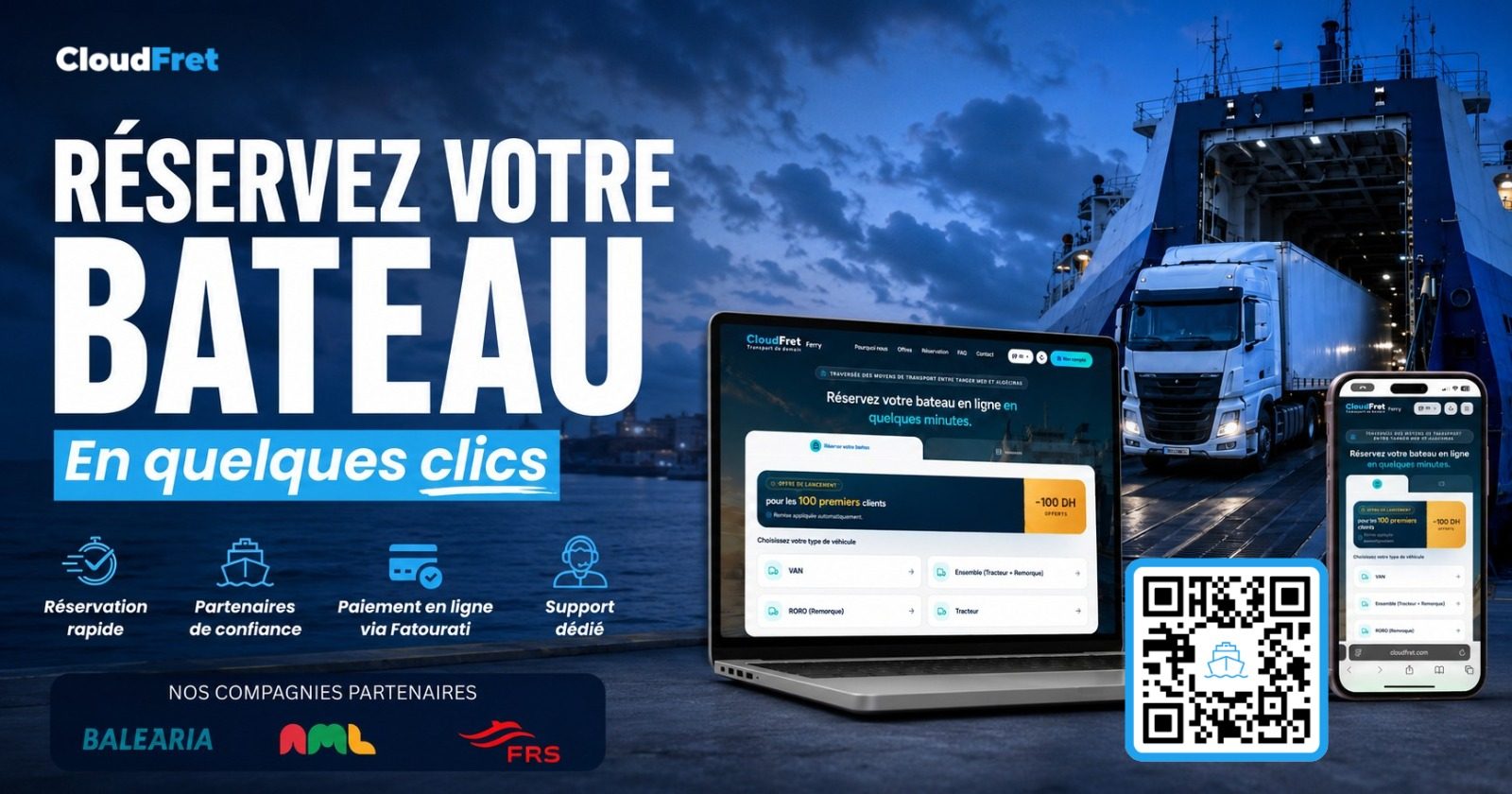
We are launching CloudFret Ferry, an online booking service for the Tanger Med – Algeciras crossing, designed for road transport professionals.
What It Changes in Practice
- Direct booking, no intermediary. You choose your slot and confirm from a phone or computer, in 2 minutes.
- All vehicle types covered: VAN, Tractor, Combination (tractor + trailer), RORO (unaccompanied trailer).
- Rates visible before confirmation. No more quotes that only arrive after three reminders.
- Secure payment via Fatourati. A single scan settles the bill — no reference to re-enter, full traceability, faster collection.
- Dedicated support. A team that speaks the language of transport, not that of a generic call centre.
How It Works
- Go to CloudFret Ferry (or scan the QR code on our visual).
- Select your vehicle type.
- Choose your crossing.
- Pay online via Fatourati.
- Receive your boarding confirmation.
Launch Offer
−100 DH off for the first 100 customers. The discount is applied automatically, with no code to enter.
5. FAQ
Who can use CloudFret Ferry? Any goods transport professional operating on the Morocco–Spain route: domestic and international carriers, freight forwarders, and shippers with their own fleet.
Which vehicle types can I book? VAN, Tractor only, Combination (tractor + trailer) and RORO (unaccompanied trailer).
How long does the Tanger Med–Algeciras crossing take? About 1 hour 30 minutes, depending on the operator and sea conditions, over a distance of 27 km — the shortest route across the strait.
How is payment made? Online, via Fatourati, the Centre Monétique Interbancaire platform connected to 32 banks and payment institutions in Morocco. Scanning the QR code is all it takes to access the invoice and pay it.
What happens if a crossing is cancelled because of the weather? Crossings of the strait can be suspended during spells of rough sea. Online booking lets you track the status and reschedule without going back through an intermediary.
Can the launch offer be combined with other offers? The 100 DH discount is applied automatically to the first 100 customers, subject to availability.
Conclusion
Morocco–Europe road freight has grown in volume, professionalism and tools. What it still lacked was a way to treat the crossing of the strait as what it is: a logistics segment in its own right, one that deserves to be booked, paid for and tracked as simply as the rest of the chain.
That is what CloudFret Ferry does.
👉 Book your crossing on CloudFret Ferry — 2 minutes, from your phone or PC.
Logistics that moves forward with you.
- Reopening the Strait of Hormuz: What Will Really Happen to Oil and Freight?
- Nador West Med 2026: What Morocco’s Second Deep-Water Port Changes for Logistics Between Europe and Africa
- CloudFret Featured in Challenge.ma: Five Years Reshaping Road Freight Between Europe and Africa
- 80% Dependence: How Morocco Supplies Spain and Secures Europe’s Agriculture
- Hormuz Crisis: SIPORTS 2026 Drives Morocco’s Port and Logistics Transformation