Nador West Med 2026: What Morocco’s Second Deep-Water Port Changes for Logistics Between Europe and Africa
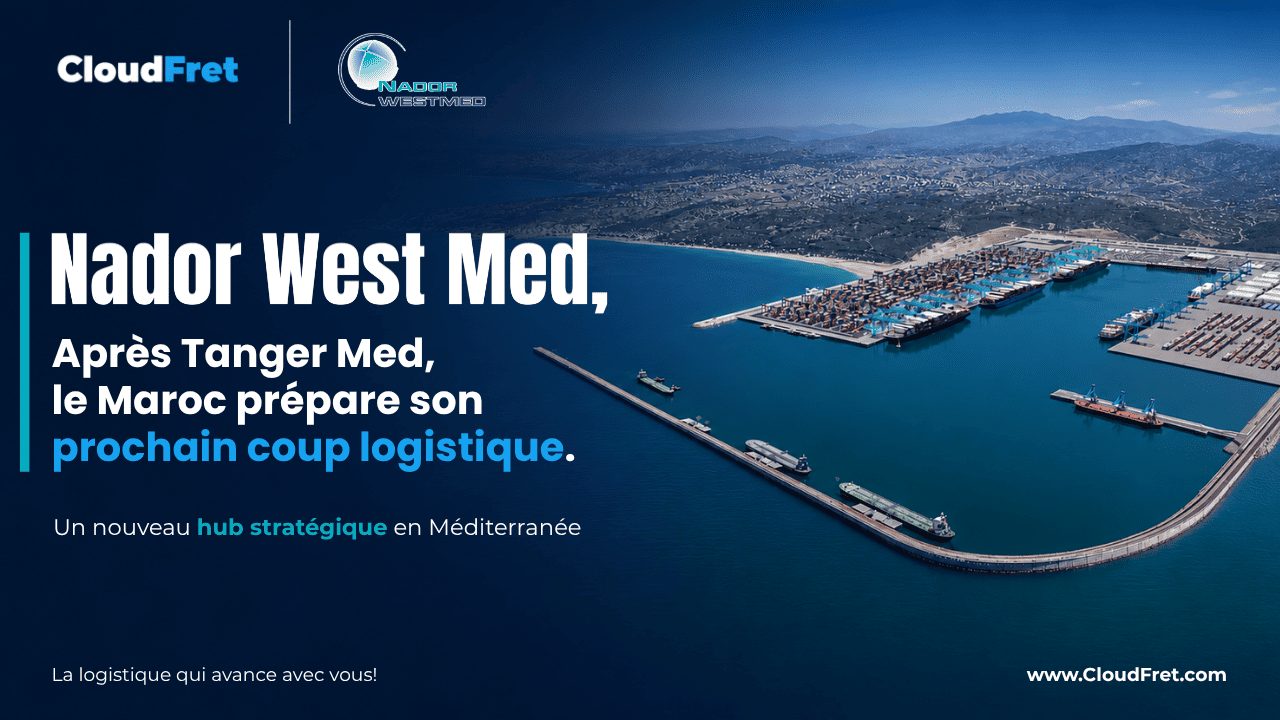
On 28 January 2026, the Royal Palace confirmed that Nador West Med port would enter service in the fourth quarter. A year ahead of schedule. This $5.6 billion project rests on two concessions signed with CMA CGM and MSC. Its land network stretches from Fez to Saïdia. Beyond the maritime perimeter, Nador West Med is redrawing Morocco’s place in global logistics. Here are the five dimensions that make it a strategic turning point for the entire ecosystem.
Why Nador West Med Marks a Turning Point for Logistics in Morocco
For almost twenty years, Tanger Med has shown what a well-designed Moroccan port can achieve. The Mediterranean’s leading port. Africa’s leading port. These rankings are no longer targets. They are positions won and defended against historically dominant European hubs. This success has changed the strategic equations of shipping lines, shippers and international logistics operators.
With Nador West Med, the Kingdom is moving from a single port to a genuine port system. This is a major transition. A country with two global maritime hubs plays in a different league. It offers routing options. It spreads its operational risks. It negotiates differently with the major shipping lines. And it extends its influence over the Mediterranean as well as the Atlantic.
The maturity Moroccan logistics has reached plays a key role here. Experienced port operators, digitalised carriers, modernised customs, proven free zones: Nador West Med is not starting from a blank slate. The port extends a model that has already been fine-tuned. That is what makes the promise credible.
Nador West Med in Figures: A World-Class Project
Before analysing the strategic implications, it is worth grasping the scale of the project. The official figures from the Royal Palace and the Ministry of Equipment describe infrastructure designed for the decade ahead. Not for immediate needs.
$5.6 Billion and 12 Million Containers in the Long Run
Nador West Med represents a public and private investment of 51 billion dirhams. That is $5.6 billion. Initial capacity stands at 5 million containers a year. It can be expanded to 12 million in the long run. By way of comparison, Algeciras handled 4.7 million containers in 2024. Valencia handled 5.5 million. Nador West Med’s container capacity therefore places the port squarely in the league of the major Mediterranean transhipment hubs. From day one.
The maritime infrastructure is already complete. It comprises 5.4 km of breakwaters, 4 km of quays and four energy stations. This head start on the physical works explains why the opening could be brought forward by almost a year from the original 2027 plan.
Two Landmark Concessions: CMA CGM and MSC
Two container concessions were signed even before the opening. That is a strong vote of confidence from international shipping lines. The West terminal will be operated by Marsa Maroc in partnership with CMA Terminals, a subsidiary of the CMA CGM group. The second terminal will be awarded to MSC through its subsidiary Terminal Investment Limited, also in partnership with Marsa Maroc.
Seeing the world’s two largest shipping lines committed at the same time to the same port under construction is no small detail. It is a strong indicator. The major shipping networks are already building Nador West Med into their transhipment plans for 2027 and beyond. This points to a rapid ramp-up as soon as the port actually enters service.
An Integrated Energy and Industrial Complex
Beyond containers, the complex will house the Kingdom’s first LNG terminal. Its annual capacity will reach 5 billion m³. A hydrocarbons terminal will complete the whole. These facilities serve a national energy-security objective. At the same time, they create specialised maritime activity that complements container traffic.
On the industrial side, the Nador West Med industrial zone covers 700 hectares dedicated to logistics and manufacturing activities. Nearly 20 billion dirhams of private investment has already been committed there. Even before the port opens. This figure is telling. Manufacturers and logistics operators are anticipating the opening. They are positioning their assets ahead of time. That lends credibility to the traffic forecasts.
Land Connectivity: The Real Key to Success
A strategic port, however modern, is only valuable if it is connected. Connected to reliable, fast and well-orchestrated land logistics. That is precisely what the Moroccan authorities have planned for. Three major infrastructure projects accompany the port’s entry into service.
The Guercif–Nador Motorway
The new Guercif–Nador motorway, about 105 km long, will connect the port complex to the national motorway network. It will run via the Fez–Oujda axis. The project benefits from €246 million in financing mobilised by the African Development Bank. This secures its delivery. A first section is due to be completed by January 2028 at the latest.
For import-export flows, this motorway changes everything. It makes the difference between a geographically isolated port and a port integrated at the heart of the national economic network.
The Selouane–Nador West Med Rail Link
In parallel, ONCF is building a 50 km rail link between Selouane and Nador West Med port. This connection is essential. It will absorb heavy volumes. It will link the port to the rest of the national rail network, which extends to the trans-African Cairo–Dakar corridor. The African Development Bank has expressed interest in co-financing the project. That is a further sign of the project’s regional importance.
Widening the RN2 Between Fez and Nador
The widening of National Road No. 2 between Fez and Nador to dual carriageway is in its final phase. It will put the Fez-Meknes region less than two hours from the port. This transforms the economic geography. A dense industrial region — automotive, agri-food, equipment — gains direct access to a maritime outlet that offers an alternative to Tanger Med. Without the congestion of the north-western routes.
For shippers in Fez, Meknes, Taza and beyond, the calculation changes in concrete terms. Export costs and lead times are being redrawn.
Tanger Med and Nador West Med: Complementarity Rather Than Competition
The question often comes up in conversation. Will Nador West Med cannibalise Tanger Med? The answer is clear: no. Judging by the strategic choices made, the two ports are positioned to complement each other. Across different catchment areas and different types of traffic.
Tanger Med will remain the main hub for Atlantic–Mediterranean traffic. It will continue to carry the core automotive and textile flows of north-western Morocco. Nador West Med will primarily capture flows from the Oriental region, the north-east and the Fez-Meknes corridor. It will also handle transhipment to and from the eastern Mediterranean. Together, the two ports widen the Kingdom’s catchment area. They do not fight over it.
This complementarity extends to industrial infrastructure. Tanger Med has built its ecosystem around the automotive and aerospace industries. Nador West Med has a more diversified remit. Energy, agri-food, industrial equipment: all of it backed by an LNG terminal that is unique in the Kingdom. The country thus equips itself with two hubs with distinct profiles. This spreads the risks of sectoral and geographical exposure.
What Moroccan Businesses Need to Prepare for Today
For businesses, Nador West Med is not a new line on a map. It is a reshuffle of the operational deck. A reshuffle worth anticipating before the opening. Not discovering after it.
First, a new geography of flows. Businesses in the Oriental region, the north-east and the Fez-Meknes region will have access to a direct maritime outlet. Without having to route everything through Tanger Med. That means shorter lead times, lower pre-carriage costs and new routing options to weigh up. This flexibility has real value. Especially at peak times or when one of the two corridors is disrupted.
Next, a real industrial opportunity. The 700 hectares of free zone adjoining the port are not a theoretical land bank. Nearly 20 billion dirhams of investment has already been committed there. Export industries — automotive, agri-food, textiles, equipment — will have a new production platform. Facing Europe and West Africa.
Finally, a structural reminder. Value will not be created automatically. It will be created for those who have planned ahead. For those who have built their routings, carrier partnerships, customs procedures and operational visibility in advance. The future of Moroccan logistics will not be decided in public infrastructure alone. It will be decided by companies’ ability to coordinate, anticipate and deliver reliably.
The CloudFret Vision: From Port to Last Mile
At CloudFret, we are watching this transformation with one simple conviction. Morocco is ceasing to be a transit country and becoming a genuine connected logistics hub. And a hub is not a dot on a map. It is a system. A system where every journey, every document, every deadline counts. And where data moves as fast as goods.
Tanger Med has shown that a Moroccan port can compete with the best Mediterranean hubs. Nador West Med will show something else. Morocco can sustain not one but two world-class maritime hubs. Complementing rather than cannibalising each other. And it is precisely this complementarity that defines a genuine hub. Complementarity between ports. Between regions. Between modes of transport. Between public and private players.
Our role, as a logistics coordination player, is to support this change. To give businesses the tools to orchestrate their flows end to end. To cut downtime. To streamline coordination between carriers, shippers and port operators. Because in 2026, delivering is no longer enough. You have to deliver with visibility, traceability and reliability.
Frequently Asked Questions About Nador West Med
When Will Nador West Med Port Enter Service?
On 28 January 2026, the Royal Palace confirmed that Nador West Med port will enter service in the fourth quarter of 2026. That is almost a year ahead of the original 2027 timetable. The maritime infrastructure — 5.4 km of breakwaters, 4 km of quays — is already complete. The port will be brought into service in phases, as the terminal concessions become operational.
What Will Nador West Med’s Capacity Be?
Initial capacity is 5 million containers (TEU) a year from opening. It can be expanded to 12 million in the long run. The port will also handle 35 million tonnes of liquid and dry bulk. This capacity immediately puts Nador West Med on a par with Algeciras and Valencia. The two main European hubs in the western Mediterranean.
Who Will Operate the Container Terminals?
Two concessions were signed before the opening. The West terminal will be operated by Marsa Maroc in partnership with CMA Terminals, a subsidiary of the CMA CGM group. The second terminal will be operated by MSC through its subsidiary Terminal Investment Limited, also in partnership with Marsa Maroc. The presence of the world’s two largest shipping lines is a strong vote of confidence in the project.
How Will Nador West Med Benefit Businesses in Morocco’s Interior?
The Ministry of Equipment has announced an ambitious connectivity plan. The Guercif–Nador motorway, financed by the AfDB. The Selouane–Nador West Med rail link. The widening of the RN2 between Fez and Nador to dual carriageway. Wider roads to Taourirt, Al Hoceima, Oujda and Saïdia. The Fez-Meknes region will be less than two hours from the port. This creates a new export corridor for the centre of the country.
Morocco Is Moving Forward, and Logistics Is Expanding
Morocco is moving forward. Logistics is expanding. And as early as the end of 2026, Nador West Med could well open a new door. A door to what the Kingdom’s logistics decade will look like. For our customers, our carrier partners and the whole ecosystem, the message is simple. This is not the time to wait. It is the time to prepare.
→ Read the Royal Palace’s official announcement: statement of 28 January 2026
→ Reuters / Maritime Executive analysis: Nador West Med to start up ahead of schedule
Related Articles:
- CloudFret Featured in Challenge.ma: Five Years Reshaping Road Freight Between Europe and Africa
- Logistics 4.0 Unleashed: Transforming the Future of Transportation and Logistics
- CloudFret Reaches a New Milestone: 4,600+ Users in Our Community
- Morocco 2024: Key Logistics Developments Unfolding!
- Hormuz Crisis: SIPORTS 2026 Drives Morocco’s Port and Logistics Transformation
- Full Truckload (FTL) Vs. Less Than Truckload (LTL) Shipping: Which Option Should Your Company Choose?